Sunday, April 24, 2011

Boys, girls and swords

Maisie Williams as Arya Stark (Image: HBO & Stellar Four)
Let me lay my bias on the table right away: I'm a huge fan of George R.R. Martin's series of doorstop-size fantasy novels collectively titled A Song of Ice and Fire.  And no big-screen cinema event this year eclipses, in my mind, the unveiling last Sunday night of HBO's new ten-episode, small-screen adaptation of the first volume, A Game of Thrones.  For the most part, it did not disappoint me - more on that in a few weeks when I put up a fuller review, after I've absorbed the initial installments. 

So clearly, I'm far from objective when evaluating criticisms of the series - especially the significant number of accusations floating around in the online chatter, from professional critics and blog commenters alike, that the grim, graphically violent and sexual show is misogynistic.  A pretty representative sampling includes pop culture columnist Whitney Matheson at USA Today ("a 13-year-old boy's wonderland"); an articulate-if-enraged Salon reader going by the handle of Setsuna777 ("Sexually violent, sexist, nauseating"); and, to a lesser extent, critic Ginia Bellafante in an already semi-notorious New York Times pan that didn't explicitly address issues of misogyny but dismissed the entire fantasy genre, and GoT in particular, as "boy fiction" that no woman she knows would bother with. 

My own pre-formed opinions notwithstanding, I think I'm on solid ground when dismissing these complaints, almost (but not quite) entirely - and I say that with full awareness that, given the pervasive sexism that still exists in contemporary entertainment, a feminist is well justified in approaching what she watches with some skepticism. 

Saturday, April 23, 2011

How do you say "Nouvelle Vague" in Cantonese?

(Image filched from Eigawatchlog)
Among the nice things about being really sick, besides the raw throatful of gluey phlegm and the sensation of having been beaten all over by hammers, is that you can sit around and watch a bunch of DVDs without feeling guilty about the other, practical stuff you ought to be doing or the people you ought to be out socializing with.  So this post comes to you courtesy of some sort of flu virus.  Thanks to said microorganism and its rapidly multiplying family, I was able recently to get through a few more of the Hong Kong movies in a stack I borrowed about a year ago from a friend, which remains embarrassingly unfinished (the stack, not the friend... although... well, anyway).

On a whim, I concentrated on rare, hard-to-find crime movies from the "Hong Kong New Wave" of the late '70s and early '80s, mostly in the form of DVD-Rs copied from crummy, full-screen VHS tapes, one of them without even subtitles.  Admirable dedication or masochism?  This question is left as an exercise for the reader.

The paradox of plenty.

Sometimes it's hard living in a culturally rich and diverse city.  Here are the film-related events that are competing for my finite time and money over the next week or so:

The W.C. Fields retrospective at Film Forum.  The late films of Indian master Satyajit Ray at Lincoln Center.  The retrospective of Japanese director Kaneto Shindo at BAM Rose Cinemas, including his never-before-seen-in-the-U.S. classic Children of Hiroshima.  The retrospective of pioneering Soviet master Dziga Vertov at Anthology Film Archives.  And of course the Tribeca Film Festival, with dozens of every kind of movie, including the latest blockbuster starring the great Hong Kong star Chow Yun-fat.  This is to say nothing of the new movies in general release that I actually want to get around to seeing, including Insidious, Hanna, Incendies, Meek's Cutoff, Blank City, Certified Copy, and I can't even remember what else.  Plus there's all those other things that aren't movies.  Yes, I do some of those things.  And only one of them is work.

So if you haven't seen anything in this space lately, that's my excuse: my brain is melting and I'm sinking into a slough of despair over all the things I have to abandon seeing in order to see any of the other things.  Expressions of heartfelt sympathy are hereby solicited.


(image courtesy of TVRecappersAnonymous)

Thursday, April 7, 2011

Does everyone care about Uncle Boonmee? Should everyone?

(Image courtesy of Kick the Machine and San Francisco Museum of Modern Art's blog)

In his rave review in the current issue of Film Comment magazine, Chuck Stephens makes the rather remarkable statement that "everybody who cares about cinema has already long been stoked about seeing Uncle Boonmee."  In case you are somebody who Just Does Not Care About Cinema, I shall inform you that he refers to Uncle Boonmee Who Can Recall His Past Lives, the latest feature by Thai avant-garde filmmaker Apichatpong "just call me Joe" Weerasethakul and the upset winner of the Palme d'Or for best picture at last year's Cannes Film Festival.  As usual for The Joe, it includes Buddhist and animist mysticism, animal transmogrifications and ruminations on reincarnation, references to Thai folklore and more oblique references to Thai history and politics, homey low-key humor, and lots and lots of jungle vegetation and chirping cricket sounds.  I suppose this is as good a paragraph as any to fulfill my obligations under the law governing all writers on Uncle Boonmee by mentioning the monkey ghosts with glowing red eyes and the disfigured princess who receives oral sex from a talking catfish.

Now, as someone who Cares About Cinema, and who is furthermore a fan of Weerasethakul's work, I was certainly stoked about seeing it long before I did last fall at the New York Film Festival, and was almost equally stoked about seeing it a second time, as I did last month at Manhattan's Film Forum when it was finally released for a U.S. run.  But the combination of that second experience and Stephens' above-quoted assertion got me thinking again about the gap between the quite small group of cosmopolitan-intellectual-professional film pundits and the more-or-less-casual paying audience, and how wide that gap often is even in the cineaste circles of a town like New York.

Monday, March 28, 2011

Better than the book. There, I said it. Don't like it? Talk to the guy in the bearskin.


"Either o' you in need o'... medical attention?"
Ed Corbin in the greatest performance in film history
.
(Image courtesy Paramount Pictures & Tattered Banners)

Earlier this month I finally got around to seeing the Coen brothers' latest, True Grit.  Even I was surprised at how long this took me to do, despite having wanted to see it since long before opening day, which was Christmas.  But that often happens with me and big mainstream movies - it feels like I'll have a million chances to see it, while every week there are tempting little rarities beckoning from every repertory screening venue in New York City.  There are Icelandic silent comedies and Iranian science fiction musicals to see, dammit!  (I've actually never heard of an example of either, but if they turned up, I would pay to see them without hesitation.)


Regardless of why the buildup took so long, the payoff did not disappoint.  Sue me, but I liked it even better than Charles Portis's cult classic 1968 novel, which I'd made a point of reading beforehand and found very fine.  The Coens faithfully retain most of the virtues of Portis, but the addition of thick layers of visual and aural texture just enhances them.  The author’s telling of the story in the deadpan first-person voice of Mattie Ross, the 14-year-old girl on a hunt after her father's killer through wild Western territory, was an inspired choice, exquisitely carried out.  But Mattie's matter-of-factness meant that there wasn’t much dwelling on atmosphere.  The Coens, remarkably, retain a sense of Mattie’s voice and point of view without much resort to voiceover narration from the novel - largely through the medium of Hailee Steinfeld, the 15-year-old outta-nowhere star.  Steinfeld inhabits the unnervingly self-possessed Mattie with, well, unnerving self-possession; she rules most of the scenes she's in even when she's sharing them with a Jeff Bridges or a Matt Damon at their respective bests, just as her character continually bends jaded, leather-tough adults around her finger through sheer will.  The paradoxically tough-as-tree-bark gaze of her big, soft eyes in her baby-fat-rounded face is the sound of Mattie's voice translated into an image.

But on top of this, the movie adds the feel of the dust on our skin and in our hair, the bite of the prairie wind, the smell of men, old and not-so-old, rotting from the inside and covered in the detritus of their hardscrabble lives.  Much of the credit for this, of course, belongs to the brothers' typically painstaking visual and sound design.  But no small part has to go to their seldom-erring instinct for casting, which as usual goes beyond the leads.  Even in bit parts, the Coens scatter around perfect faces and voices that don't look and sound like "movie people."

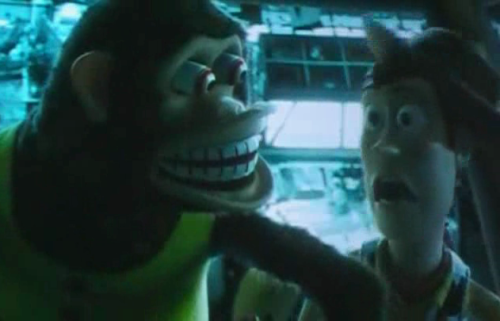
Best of all is some guy named Ed Corbin, who totally looks like an  Ed Corbin, and, as the bearskin-sporting, self-described doctor with just one brief scene, may be the greatest thing to happen ever (EVER!) in a movie aside from the monkey guard in Toy Story 3.  In a movie that's practically an essay in the many possible variations on “thick-tongued, rumbly-chested Western drawl” that can come out of the male human face, he towers above them all.

True Grit the movie is also a lovely demonstration of the way that authors and their screen adaptors, so often placed at odds by commentators, can help each other out.  Much of Portis’s dry humor is enhanced when presented through the voices and faces of these actors, while the Coens' often overweening love of cartoon grotesquery is reined in by Portis’s hard-eyed reserve.  On the evidence of this and the even more breathtaking No Country for Old Men, maybe the Coens ought to stick to hard-bitten literary adaptations and leave off the gooney comedies.  I might start to love them again the way I did back in the days of Miller's Crossing and Barton Fink.


[UPDATE: Here's a short, entertaining L.A. Times piece about Ed Corbin and his appearance in the movie.]
(Image courtesy Simon & Schuster and Encyclopedia of Arkansas)

Sunday, March 27, 2011

78 cents per minute, and cheap at the price.

(Image courtesy Studio Ghibli and Carnegie Hall)

I have a sickness.  It's called cinephilia.  The more specific sub-strain currently afflicting me is Miyazakiphilia.  Last night I spent $21 to see two short films that totaled 27 minutes together.  And I don't regret it.  In fact, I'd do it again if I could.  Unfortunately, I can't.

Last week I noticed that Carnegie Hall, as part of the JapanNYC arts festival, was somehow showing two of the eight shorts that animation god Hayao Miyazaki has made for screening exclusively at his museum in suburban Tokyo devoted to the work of his production company Studio Ghibli.

If you don't know who Miyazaki is, it's tough to explain succinctly why reading this announcement made me shriek like a four-year-old handed a new puppy and painfully clutch the arm of the nearest stranger (this interview piece in The Telegraph is a good start).  Within the world of Japan's animated cinema, and those in the rest of the world who pay attention to it, Miyazaki is the equivalent of, say, a Bob Dylan: an almost universally beloved popular figure who is also a singular, uncompromising, even eccentric artist who's innovated his own distinctive style and vision that remains inimitable while being hugely influential.  His child-friendly but not childish fantasies eat domestic box office records whole and also pick up awards from highbrow European film festivals and Hollywood's middlebrow Academy Awards alike.  And it's not as if his fans have a huge amount of work to choose from, or ever will - a painstaking creator with the financial success to set his own timetable, he's directed ten feature films total starting in 1979, and keeps announcing his retirement from directing and then taking it back.

And he's a stubborn old cuss who, as the Carnegie Hall program emphasized with sadistic relish, has never allowed any of his Ghibli Museum shorts to be shown outside that venue, and supposedly never will again - they must have drugged his drink, or kidnapped his grandchildren, or something.  However they did it, they had me there at "Miyazaki," and I probably would have paid $50 if I'd had to.

The evening began with a short introduction by American Ghibli executive Steve Alpert, who spoke simply and unsentimentally about the studio's reaction to the earthquake and tsunami disaster.  Miyazaki gathered the staff together and told them that the best thing they could do was keep making the work they did... besides, of course, fundraising and clothing drives and food drives, which they're also conducting, in addition to setting up DVD screenings for children stuck in shelters.  Then he gave some quick comments on cultural and other background to set up the shorts - which, given that most people will likely never have a chance to see them, I'll describe in more detail than I normally would.

(Image courtesy Studio Ghibli and Carnegie Hall)
The first, House Hunting (Yado-Sagashi), is a 12-minute story which sets a redheaded young girl off with a big, stuffed backpack, briefly hiking down the side of a deafening, crowded highway before setting off across the countryside, over streams and hills and through woods.  Along the way, she has glancing encounters with various nature spirits, each of which she greets cheerfully with an offering of an apple and a polite bow (in what I'm sure was an unintentional echo, the giant tadpole-like apparition in a stream reminded me of the much more dangerous water beast in the great Korean monster movie The Host, released the same year, 2006).  She eventually comes to an isolated cabin where she takes shelter from a rainstorm and shares her lunch with a scuttling host of wide-eyed, friendly bugs - not noticing the enormous black millipede-like creature (another spirit?) that zooms around out of sight, eventually exiting in apparent fright.  After a good night's rest in her sleeping bag, she awakes to the presence of a shuffling, vaguely Sasquatch-like spirit, and seems to realize that this is not her house to occupy after all.  Quickly packing up, she hikes back the way she came, although at one point the hairy occupant of the cabin tosses her a big sack of goodies over the trees, which she takes after leaving an offering for him.

Fans will instantly recognize in the narrative a lot of Miyazaki tradmarks - the intrepid prepubescent heroine, the skeptical view of technological civilization and the love of the natural world, the fascination with quasi-mythological mysticism, the superficially menacing creatures which would be typed as a threat in a Disney animation, but in fact turn out to be harmless.  Stylistically, though, it's pretty experimental.  The images are graphically simple and rendered in bright primary colors and deliberately rough-hewn animation.  The entire soundtrack - mostly sound effects with just a few brief phrases of dialogue - is created by two human voice performers, with the sound effects also represented in big onomatopoeic Japanese characters that fly, quiver and tumble across the screen.  The overall feeling of enthusiastic oral storytelling and naive, childlike play inspired butterflies of joy in my stomach, and I wasn't alone judging from the reactions around me.

The everyday glories of nature are also central to the 15-minute Mon Mon the Water Spider (Mizugomu Monmon), inspired by an actual species that apparently fascinates Miyazaki - an arachnid that lives underwater but breathes air which it collects from the surface in big (to the spider) bubbles.  We watch our hero Mon Mon's routine of gathering air and building bubble nests while trying to avoid being eaten by the many bigger carnivores in his pond.  Then he notices a cute female water strider zipping gracefully along the surface, in contrast to his scuttling, furtive existence, and is smitten.  He pines hopelessly and watches from a distance, eventually saving her from being eaten (by an awesomely scary-cool clawed crustacean of some sort).  Confused and frightened, she flees unceremoniously.  But she returns for a climactic brief encounter wherein he hangs onto her two front legs for a thrilling, dancelike zoom around the surface of the pond at top speeds.  After almost being eaten by a big fish, they inevitably part, returning to their separate worlds to the melancholy awwwing of the audience.

The second movie is a striking stylistic contrast to the first, marked by a startling re-creation of the story's natural environment so realistically detailed that it looks like an animated episode of Planet Earth.  The only "cartoon" stylization is in some of the details of the two main characters - a little too much in the case of the water strider: the pink bow on her head is an atypically clumsy stumble into cloying territory. But that's a tiny nitpick in a piece so beautiful and charming, and so full of remarkable sights that it would be worth watching multiple times in a row just to catch all of them.

When the lights came up after the pair's parting, there was an audible groan of frustration from the audience - we felt like Mon Mon being torn away from our water strider and forced to scuttle back down to our bubble nests in the depths.  At that moment, I was almost ready to say it would be better to see none of these shorts than just a tantalizing two.  Would it have killed him to let us have four?  But as my Great Uncle Lester used to say, look a gift horse in the mouth and you might get your nose bitten off.  So I'll keep my nose and my pleasant memories of an experience even most worshippers at the altar of Miyazaki never get to have.

Saturday, March 26, 2011

The Good, The Bad, and The More-or-Less Good Enough

(image courtesy of IFC Films and IMPAwards.com)
“Life is about chasing and being chased,” says a character in The Good, The Bad, The Weird.  Which is the closest director/co-writer/co-producer Kim Jee-woon comes to a philosophy here, unless it’s “I want to make a movie that’s going to be huge in Korea and probably sell okay in the U.S., too.”

Which he did – it became the second highest-grossing movie of 2008 in its homeland and got the usual limited specialty release here last year.  For one reason or another, I didn’t see it until the Brooklyn Academy of Music’s Rose Cinema did a Kim retrospective about a month ago, another manifestation of their commendable habit of showcasing Korean cinema.

Whether or not you think Kim is worthy of his own series at a leading arthouse theater probably depends on whether or not you think the commercial mass entertainment of other cultures is worth paying attention to even in those cases where it’s not transcendent art.  I come down firmly on the side of “Yes,” as will be clear to anyone who bothers to follow this blog for a while (anyone?  anyone?) – so I was happy enough to plunk down my cash at the box office for the latest bit of gorgeous if only partly satisfying fluff from this filmmaker.  (But I do have to chuckle a bit at the marketing chutzpah of calling the series "Severely Damaged," when Kim is scarcely the grittiest or most trauma-fascinated of his country's filmmakers.)

Easily my favorite Kim product is The Foul King (2000), a rambunctious but melancholy comedy about masked wrestling as an antidote to workplace humiliation and other disappointments of adult life.  It’s the only one of his movies I’ve seen that has some sincerity and individual personality.  Otherwise, his career looks like a magpie’s nest of shiny tidbits collected from various genres, movies and moviemakers.  In A Tale of Two Sisters (2003) he did his lanky-black-haired-female-ghost movie with a twist ending.  With A Bittersweet Life (2005) he did his mob-killer-who-has-a-change-of-heart thriller/melodrama.  Both are well-executed, absorbing, extremely easy on the eyes and kind of forgettable.  None of that changes with The Good, The Bad, The Weird.

Its first reference point is obvious right from the title, lifted, like the lead characters and the basic story, from Sergio Leone’s so-definitive-I-shouldn’t-even-have-to-name-it spaghetti Western.  You’ve got your psychotically murderous gunman, you’ve got your taciturn, relatively more moral gunman and you’ve got your amoral , jabbering goofball gunman, and they’re all alternately competing and cooperating in a quest for buried treasure in a war-wracked desert setting, although in this case it’s Japanese-occupied 1930s Manchuria, rather than the Civil War-era American Southwest as played by Spain.

But the resemblance to the genre Kim is supposedly saluting largely ends with this setup – the execution owes a lot more to Hong Kong’s acrobatic crime-action movies and the post-Tarantino style of facetious violence blended with obsessive quoting of classic and cult cinema.  Kim, as usual, buffs the jerry-rigged, awkwardly welded contraption into exquisite eye candy – the first half glows with the Jolly-Rancher-colored beauty that even routine Korean filmmakers are able to produce with apparent ease (when the story retreats to the desert in the second half, the inevitable preponderance of browns and yellows is a disappointment).

It’s too bad his visual skills drop off when he needs to go beyond shooting pretty pictures – insert here the standard complaint about how young action directors nowadays can’t hold their damned cameras still for just a few seconds, produce a smooth tracking shot, or edit together a fight scene coherently.  The mayhem has lots of imaginative and funny choreography (one of my favorite bits is when the Weird wades into a shootout in a protective but none-too-convenient metal diving helmet).  But it’s often frustratingly obscured by a shakey image and fast cutting, to the point that I felt a twitchy urge to wave my right hand in front of my eyes as if there were cobwebs obscuring my view.

The biggest thing Good, Bad, Weird has going for it is actor Song Kang-ho – but that’s true of a lot of movies with Song, who specializes in making “Everyman” roles more interesting than just about everyone else onscreen.  His character might nominally be “the Weird,” but he’s still the closest thing to a regular guy among the trio, and the beefy-faced star easily makes him the focus of the viewer’s sympathies despite the fact that he’s more or less a scumbag.  Not to give all the credit to Song.  The character is the strongest element in the screenplay by the director and Kim Min-suk - stumbling into and out of dangerous situations, perpetually befuddled but somehow always convinced of his own craftiness, always ready to shoot himself in the foot with a motormouthed commentary (his Korean chauvinism is a bit of a running joke).

Byung Hun-lee also makes an impression as “The Bad,”, turning his Johnny Depp-worthy cheekbones and doe eyes to paradoxically chilly effect as a gleefully sadistic gang leader with a quasi-erotic love of knives.  It’s a one-note performance, but a striking one, with Byung barely recognizable from his previous part with Kim as the stone-faced, sad-eyed protagonist of Bittersweet Life.  His badass image is amusingly contemporary –sleek and skinny, with a spotlessly stylish rock star/cowboy wardrobe, neo-mullet and twice-pierced left ear, he’d be laughed out of any real group of desert bandits before he’d had a chance to even reach for his gun.  I mean, just look at this picture.

Who knew they had fitness clubs in 1930s Manchuria?  (Image courtesy IFC Films and k13greenfaery's Photobucket album)
But this is the movies, and pretty, amusing absurdities are what we go to the movies for, most of the time.  This movie being full of them, it does the trick until it wears out its welcome in the final act – in particular, a would-be-climactic chase/stampede/shootout on horse, motorcycle, jeep, and foot feels an hour long, though it’s probably not much more than ten minutes.  And at the risk of having someone say something similar about this review, I’ll end it here.